UHT vs HTST Pasteurization: Which Process Fits Your Market?
Shelf life, energy cost, capital expenditure and consumer perception all push in different directions. A side-by-side breakdown for dairy and juice producers.
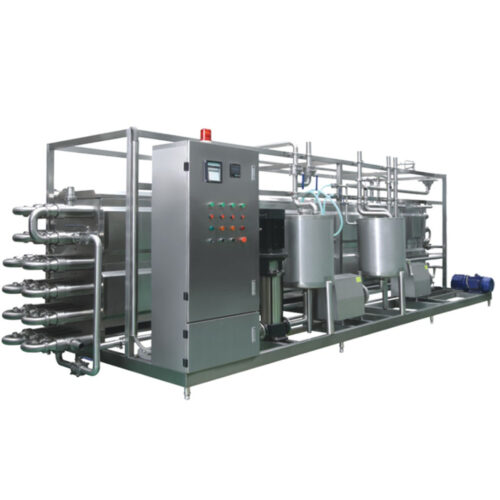
Pasteurization is the heart of any dairy or juice line. Two technologies dominate: HTST (high-temperature short-time) and UHT (ultra-high temperature). They produce the same microbiological safety, but the trade-offs in shelf life, energy cost, capital expenditure, and consumer perception are dramatic.
HTST: 72–95 °C for 15 seconds to 5 minutes
HTST holds the product at moderate heat just long enough to kill pathogens. The classic dairy spec is 72 °C for 15 seconds, run continuously through a plate heat exchanger.
The result: a product that tastes essentially identical to raw, with most enzymes and heat-sensitive vitamins intact. Shelf life under refrigeration is 14–28 days.
HTST equipment is mature, mechanically simple, and relatively cheap. A 5,000 L/h plate pasteurizer skid runs $25–45k depending on level of automation.
UHT: 135–145 °C for 2–6 seconds
UHT is sterilization, not just pasteurization. It kills not only pathogens but every spore and enzyme too. The product is then aseptically filled into airtight containers — typically Tetra Pak.
The result: a shelf-stable product that needs no refrigeration. Shelf life is 6–12 months on the supermarket shelf.
The taste is noticeably different — slightly cooked, slightly caramelized. In Western markets this is often perceived as "lower quality." In markets where cold chain is unreliable, it's the only way to distribute fluid milk at all.
Which one is right for your market?
Three questions decide it.
1. Is your distribution refrigerated?
If yes — supermarkets with reliable refrigerated display, refrigerated trucks, refrigerated warehouses — HTST is the obvious choice. Lower capex, lower opex, better-tasting product.
If no — open-air markets, long inland distances, intermittent power — UHT is the only viable option. Period.
2. What's your competition doing?
Consumer expectations are set by the dominant local product. In Nigeria, Lagos consumers expect UHT milk because that's what's been on shelves for 30 years. Selling HTST "fresh milk" is a niche move requiring premium positioning.
In Vietnam, the market is split — both HTST and UHT have established consumer bases. In Brazil, HTST dominates the urban centers but UHT serves the interior.
3. What's the energy cost of operation?
UHT consumes 3–4× more energy per liter than HTST. In a country with cheap electricity (US, Northern Europe) the gap is bearable. In sub-Saharan Africa or South America where power costs $0.15–0.25/kWh, UHT can add $0.04–0.07 to the per-liter production cost.
Capital cost: a real comparison
- HTST 5,000 L/h plate pasteurizer: $30–45k. Add CIP system, balance tank, controls — total ~$70k installed.
- UHT 5,000 L/h tubular sterilizer + aseptic tank: $120–180k. Add aseptic filler, sterile air system, full PLC — total ~$320k installed.
That's roughly 4.5× more capex for UHT. Not counting the higher cost of Tetra Pak filling versus simpler bottle / pouch fillers.
The hybrid play
If you serve both modern retail (cold chain) and traditional retail (no cold chain), consider running both processes. Build a single line with HTST as standard, then add a UHT module downstream that you can switch in for ambient-stable batches.
This is what most successful dairies in West Africa and Southeast Asia have done. It costs about 1.4× a standalone HTST line, but lets you serve both market segments with one facility.
The wrong question is "which process is better." The right question is "which process matches my market." Both technologies make safe, profitable dairy. The economics decide.
Have a question about your project?
Tell us your target capacity and product spec — we'll come back with a sized line and budget within 24 hours.